Pages

Search

Wednesday, July 18, 2012

Fuel from Plastic Waste

In Japan plastic waste processed into electricity,and now plastic waste processed into gasoline by Filipinos. Reported by Reuters, this guy finds a way to turn plastic into diesel, gasoline and kerosene through a technique called pyrolysis. Even so, Navarro refused to say that this process discovered by him.

Navarro said, the process is very simple. first plastics were collected, crushed and dried. Then the processed plastic was decomposed by means inserted into the high-pressure air heating chamber. Inside this room, the plastic will melt and then distilled to become a golden liquid that chemically identical to regular fuel.

All processing was done by a company called Polygreen Technology and Resources, who said that the fuel that produced better than regular fuel because of less pollution generated by the combustion process and fuel quality also much cleaner because it contains less sulfur. 

Not to mention due to the abundant amount of raw material and less operating costs, the price becomes cheaper about 10 to 20 per cent than regular fuel price.

The company never had a shortage of raw materials. Of the 10 million residents of Manila alone there are 6000 tons of plastic waste every day. The fact, they only need two tons of plastic waste as fuel to produce about 1600 liters.

Currently, fuel from plastic waste has been granted permission from the Philippine government for use in industrial purposes. While for purposes of motor vehicle fuel, the government is still doing the testing process. But it is rumored that from the testing process, the results are quite promising.

If this invention successful, it could be said if the Philippines is a country that quite successful in the utilization of scrap plastic waste. Last year, the invention of light bulbs used soda bottles also could make a scene of the world
Read More >>

Monday, July 16, 2012

San Fransisco banned plastic grocery bags

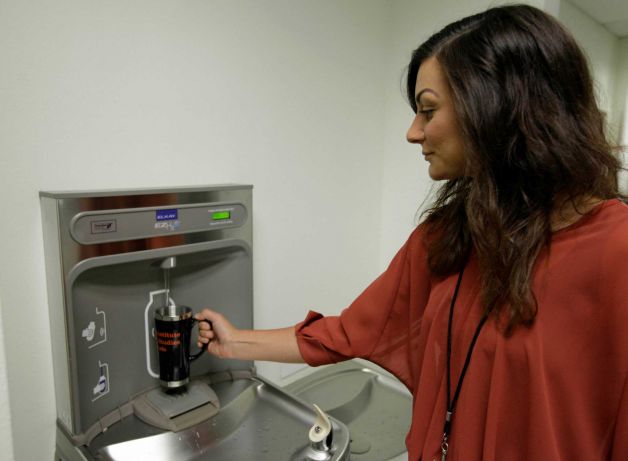
For a city that has banned plastic grocery bags and McDonald’s Happy Meal toys, you might expect a similar approach with plastic water bottles. City officials are discussing an ordinance that would, instead of banning plastic water bottles, encourage the use of other containers for drinking water.

According to the Associated Press, the ordinance would require new and renovated buildings to install water bottle-filling stations alongside any drinking fountains. University officials have estimated the busiest tap replaces the equivalent of 35,000 plastic bottles a month.

Adding a bottled-water spigot to existing water fountains would cost at least around $750, according to manufacturers.

San Francisco Considers Refillable Water Bottle-Filling Station Law To Reduce Plastic Water Bottle Use
In this photo taken Thursday, July 5, 2012, Shauna Barbera uses a bottled water dispenser at the California Institute of Integral Studies in San Francisco. The city that regulated Happy Meal toys and banned plastic grocery bags has a new target in its health-conscious, eco-friendly crosshairs: plastic water bottles. Photo: Eric Risberg / AP

University officials have estimated the busiest tap replaces the equivalent of 35,000 plastic bottles a month.
Chiu's ordinance calls plastic water bottles "bad for the environment," unnecessarily taking up landfill space and causing greenhouse gas emissions when cheap tap water is available. San Francisco city departments have been barred from buying plastic water bottles since 2007.

Environmental groups are supportive of efforts to wean San Franciscans from plastic water bottles.

"San Francisco has among the best drinking water in country.
Read More >>

Recycling PET Bottle in Europe and China

Closed Loop Recycling, a U.K.-based plastic bottle recycling company, has launched a campaign that seeks to significantly boost the collection of plastic bottles in London. Closed Loop says around 1.8 million metric tons of post consumer plastics are generated each year in the U.K, 580,000 metric tons of which consists of plastic bottles. As part of its campaign, Closed Loop Recycling is urging the government to review the current PRN/PERN (packaging waste recovery note/packaging waste export recovery note) system, saying that it favors overseas shipments versus domestic recycling.

Around half of all PET bottles in Europe were collected for recycling in 2011, according to a new report from European plastic recycling trade bodies EuPR and PET Containers Recycling Europe (Petcore).

bottle recycling centers
The extra 140 Kilo tones collected in 2011 represent a further 5.6 billion bottles to be recycled. The PET industry chain has worked with compliance agencies, national bodies and European recyclers to achieve the record collection of nearly 1.6 Million tones of PET bottles.

“Recycled PET is a reliable and sought-after feedstock in the PET value chain and sustainable, long life uses are being developed to utilize the growing supply of recycled PET. Whether PET bottles are recycled into another bottle, fiber, sheet, strapping tape or one of the new applications the energy saving will be significant.

Meanwhile Beijing's vast army of plastic-bottle scavengers will get an automated rival later this month, when the city introduces its first reverse vending machines that pay subway credits in exchange for returned containers.

More than 100 recycle-to-ride devices will be installed in an attempt to reduce the environmental impact of the informal bottle collection business and improve the profits of the operator, which works in an industry thought to be worth billions of dollars.

With the machines, the firm hopes to collect directly from the public and generate extra revenue from government subsidies and sales of advertising shown on the machine's screens. Waste-trade experts are skeptical that the same business model will work in China, which already has a vast and highly competitive PET recycling industry. "In the west, recycling is seen as a green activity. Incom says, however, that environmental benefits should be considered alongside economic factors.
Our real need is to complete a comprehensive recycling system."

image: made-in-china.com 


Read More >>

Sunday, July 15, 2012

The threat of plastic bags

We easily get a plastic bag when shopping at markets, supermarkets, shop, or store becomes a threat for the environment. We are not alone, worldwide; between 500 billion to 1 trillion plastic bags are used each year.

Not all of them recycled, even plastic bags can take hundreds of years to disintegrate. Most plastic bags end up in the oceans, polluting the sea as well as channel and source of water.

Accidentally swallowed by mammals and animals that depend on marine ecosystem in search of food. Each year there are one million sea mammals, reptiles, and birds die because of plastic.
The threat of plastic bags

Plastic bags are also a threat for animals on the land. Kliwon, African giraffe at the Surabaya Zoo, Indonesia, died with a plastic blob weighing 18 kg in the stomach.

Plastic bags are very difficult to decompose naturally, it took hundreds of years to disappear from the Earth, and the number of plastic bags that become litter and endanger marine ecosystems, it is proper we reduce the use of plastic bags.

To solve the problem, we must look for its roots. So actually, what makes it so easy to use plastic bags? Why we are hard to escape from the plastic bag? And what we are capable of making the switch from plastic bags?
Read More >>

Friday, July 13, 2012

Are plastic water bottles safe? Lets Find Out (2)

5. PP (polypropylene)
Are plastic water bottles safe? PP (polypropylene)
The best option for plastic materials, especially for dealing with food and beverages as a place to store food, bottled water and most bottled water for infants. Common characteristic is transparent bottles that are not clear or cloudy. Search this symbol when buying goods made from plastic.

6. PS (polystyrene)
Are plastic water bottles safe? PS (polystyrene)
Commonly used as a place to eat from Styrofoam, disposable drinking places, etc... Polystyrene materials can leak into food ingredients styrene when food is in contact. Styrine material harmful to the brain and nervous system. Besides the food, styrine also be obtained from cigarette smoke, fumes and building construction materials. This material should be avoided and many U.S. states have banned the use made of Styrofoam food places including China.

7. OTHER
Are plastic water bottles safe? OTHER
Recycling logo printed with number 7 in the center, as well as a note
- Other (SAN? Styrene acrylonitrile, ABS - acrylonitrile butadiene styrene, PC - polycarbonate, Nylon).
  • Can be found in the food and drinks such as sports drink bottles, auto parts, household appliances, computers, electrical appliances, and plastic packaging.
  • PC - Polycarbonate can be found in baby bottles, toddler cups (sippy cup), polycarbonate drinking bottles, and cans of food and beverage packaging, including cans of infant formula.
  • Main material is Bisphenol-A that can contaminatefood and beverages that may damage the hormone system, the chromosomes in the ovaries, decreased sperm production, and alter immune function.
  • It is advisable not to be used to place food or drink because of Bisphenol-A can contaminate drink or food if the temperature is increased due to heating. Ironically bottle is very likely to have the heating process, whether it be for the purpose of sterilization by boiling, microwave, or pour boiling water or hot water.
  • SAN and ABS has a high resistance to chemical reaction and temperature, strength, stiffness, and the level of violence has increased.
  • Usually found on the mixer bowl, wrapping flasks, dishes, cutlery, coffee filters, and a toothbrush, while ABS is commonly used as pipe material and lego toys.
  • SAN and ABS is one of the very good plastic material to use.

What information can be obtained from the symbol?

We must be wise in using plastics, especially plastics with codes 1, 3, 6, and 7 (especially polycarbonate), all have a chemical hazard. This does not mean that the plastic with the other code as a whole is safe, but needs to be studied further.

So, if we have to use plastic, will be safer when using plastics with codes 2, 4, 5, and 7 (except polycarbonate) whenever possible. If there is no plastic on the packaging code, or if the type of plastic is not clear (eg in code 7, which is not always a polycarbonate), the safest way is to contact the manufacturer and ask them about the type of plastic used to make these products.
Read More >>

Thursday, July 12, 2012

Are plastic water bottles safe? Lets Find Out (1)

Internationally there are set codes for plastic packaging. This code is issued by The Society of Plastic Industry in 1988 in the United States and also adopted by the institutions that developed the system code, such as ISO (International Organization for Standardization).

Generally the code is located at the base, triangular, in the triangle will have a number, and name the type of plastic below the triangle, with examples and explanation as follows:

1. PET - Polyethylene Terephthalate .
Are plastic water bottles safe?
Usually, at the bottom of plastic bottles, recycle logo printed with the number 1 in the center and writing PETE or PET (polyethylene terephthalate) under the triangle. Plastic bottles used for clear / transparent / translucent like mineral water bottles, juice bottles, and almost all other beverage bottles.
The majority of the world's PET plastic materials for synthetic fibers (approximately 60%), the textile commonly referred to as polyester PET (base material bottled 30%). PET / PETE Bottle is recommended ONE TIME USING ONLY, why? If used too often, especially are used to store warm water moreover hot, polymer coating on the bottle would melt and release carcinogenic (can cause cancer).

2. HDPE - High Density Polyethylene.
Are plastic water bottles safe? HDPE - High Density Polyethylene
Generally, at the bottom of plastic bottles, recycle logo printed with the number 2 in the middle, and writing HDPE (high density polyethylene) in the triangle. Commonly used for milk bottle with white color, tupperware, drinking water gallons, folding chairs, and others.

HDPE is a plastic material that safe to use because of its ability to prevent chemical reaction between the plastic containers made of HDPE with food / drinks are packed. HDPE is stronger, harder, more opaque and resistant to high temperatures. Just as PET, HDPE is also recommended for one time use only, since the release of antimony trioxide compounds continue to increase over time.

3. V - Polyvinyl Chloride
Are plastic water bottles safe? V - Polyvinyl Chloride
Recycling logo printed (sometimes red) with the number 3 in the middle, and writing V , V is mean PVC (polyvinyl chloride), which is the most difficult types of plastics recycling.
  • This plastic can be found on the plastic wrap (cling wrap), and bottles
  • PVC contains DEHA which can react with foods that are packed in plastic made from PVC when in direct contact with food such as DEHA is melted at a temperature of-15oC.
  • The reaction that occurs between the PVC with foods that are packed with plastic is potentially harmful to the kidneys, liver and body weight.
  • We should look for alternative food packaging that does not contain softeners, such as plastics made from polyethylene or natural materials (eg banana leaf).
4. LDPE - Low Density Polyethylene
Are plastic water bottles safe? LDPE - Low Density Polyethylene
Recycling logo printed with the number 4 in the middle, as well as the writings of LDPE
- LDPE (low density polyethylene) is a type of brown plastic (thermoplastic / made from petroleum), was used to place food, plastic packaging, and soft bottles.
  • The mechanical properties of LDPE plastic type is strong, somewhat translucent, flexible and slightly greasy surface. At temperatures below 60 ° C is very resistant to chemicals, power protection against moisture quite well, but less well for other gases such as oxygen.
  • These plastics can be recycled, either for goods that require flexibility, but strong, and has good resistance to chemical reaction.
  • Goods made from LDPE is difficult to destroy, but still good for the food because it is difficult to react chemically with foods that are packed with this material.

Continue to  Are plastic water bottles safe? Lets Find Out (2)
Read More >>

Tuesday, July 10, 2012

How To Recycle Plastic Bottles

Billions of plastic bottles are produced annually in this country, and most of it ends up in landfill sites. This is not good for the environment. The waste dumped into landfills and left alone in there, the waste would be very difficult to decompose by nature. Therefore, this present time, a lot of people started trying to make plastic bottle recycling.

Here are 4 steps how to recycle plastic bottles:
  1. Find out the company that produces the plastic bottles if the company doing plastic bottles recycling. In this time most of them, any bottled water company, will give a reward for each bottle returned to them.
  2. Clean the bottles to be recycled. Fill with water and then rinse thoroughly. You do not need to bother to use soap, because this step is simply to eliminate most of the remaining liquid, because the remaining fluids can cause odors during storage.
  3. Remove the bottle cap. But the label contained in the bottle should not be released, especially if there is a label with the triangle symbol (recycle) because if you return the bottle to the manufacturer you will not get anything.
  4. Follow the instructions of the manufacturer from which the plastic bottles are produced, how to return the plastic bottle into the company.
Read More >>